As a Computer lab manager at The University of Texas Aerospace Department,
I played a very small part on a very cool research project to build Micro Air Vehicles.
The idea started from
Dr. Maruthi Akella at UT Aerospace dept. by assigning students to do a study.
The project was to study nature and then build a small flying craft that would carry a tiny camera.
Flying insects were too small to carry a camera. Most birds were too big and most have problems or difficulty hovering.
It was found the hummingbird was the best fit for the research project. I helped the research group identify
the frame of the hummingbird. This was done by taking a full body X-ray CAT scan of the hummingbird
feathers and all. I then took the CAT scan data and digitally removed all but the bones. This allowed
the research group to study how the bird flew mechanically using only the bones. A key part was making a small craft stable in hovering flight. The research involved several departments
at
UT. UT Aerospace initiated the research, UT Zoology provided the specimens and some of the lab equipment for filming hummingbirds in flight,
and UT Geology provided the
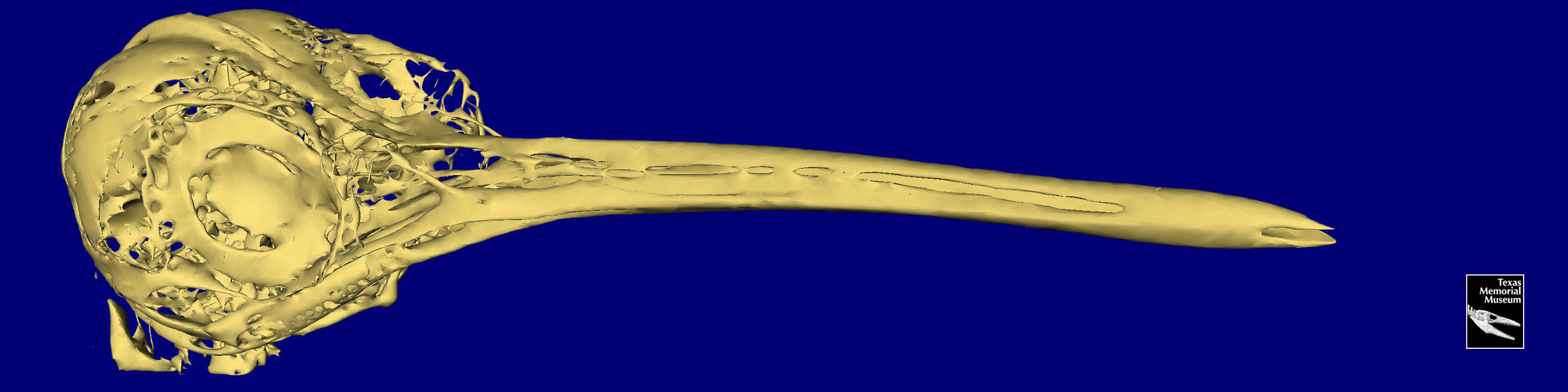
X-ray CAT scanning. Years after the project was completed the skull of the
hummingbird was use in a 3D display for The Texas Memorial Museum. Here is a link
about
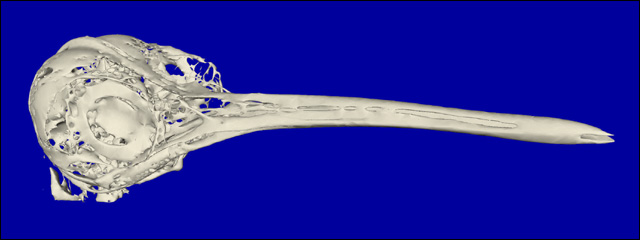
Hummingbird MAV research. Below is a 3D rendering of the hummingbird skull from X-ray CAT scan.